How To Arrange 3 Circle Mirrors On Wall: Decorative Layout
Discover the secrets to a stunning decorative layout with our guide on how to arrange 3 circle mirrors on your wall for an elegant home decor boost.
I.Introduction
There is something inherently magical about the circle. In interior design, we often deal with squares and rectangles—windows, rugs, sofas, and tables all tend to have sharp corners. Introducing round shapes softens those hard edges and brings a sense of flow to a room. When you combine this shape with the functionality of a mirror, you get a design powerhouse. However, knowing exactly how to position a trio of mirrors can be tricky.
I remember one specific project where a client had a long, dark hallway that felt more like a tunnel than an entryway. We tried a single large rectangular mirror, but it felt static and heavy. The moment we swapped it for three medium-sized round mirrors arranged in a playful horizontal line, the energy of the space shifted completely. It bounced light around the corridor and created a sense of rhythm that guided the eye forward.
If you are staring at a blank wall and holding three round mirrors, don’t worry. This guide covers everything from the math of spacing to the art of composition. For plenty of visual inspiration and real-life examples, be sure to check out the Picture Gallery at the end of this blog post.
II.Understanding the “Rule of Three” in Design
Before we start drilling holes, it is helpful to understand why three is the magic number. In design, odd numbers create a harmonious visual balance that the human eye finds naturally appealing.
An arrangement of two mirrors can often feel like a pair of eyes staring at you, which creates subconscious tension. A single mirror creates a focal point, but it can sometimes feel lonely on a large wall.
Three items force the eye to move around the display, creating a dynamic visual experience. This movement prevents the design from feeling stagnant or stiff.
Creating the Visual Triangle
When you arrange three objects, your brain automatically connects them to form a triangle. This shape represents stability and energy simultaneously.
Whether you hang them in a straight line or a cluster, you are playing with this triangulation. It allows you to fill a wall space effectively without it looking cluttered.
Breaking the Grid
Most homes are built on a grid system. You have vertical studs, horizontal floorboards, and squared-off door frames.
Using three circles disrupts this grid. It adds an organic element that makes a room feel more curated and less like a builder-grade box.
III.Essential Spacing and Sizing Rules
The success of your layout depends heavily on scale and spacing. Even beautiful mirrors will look awkward if they are floating too far apart or crowded too close together.
As a practicing designer, I rely on a few specific measurements to ensure the composition looks intentional.
The Gap Rule
A general rule of thumb for spacing smaller mirrors (10 to 18 inches in diameter) is to leave 2 to 4 inches between frames. This proximity allows them to read as one cohesive art installation rather than three separate floating objects.
If your mirrors are larger (20 inches or more), you can increase that gap to 5 or 6 inches. However, be careful not to exceed 8 inches of spacing unless you are covering a massive wall. Too much space breaks the visual connection between the items.
Height from the Floor
The center of your arrangement should generally sit at eye level. For most standard ceilings (8 to 9 feet), this means the center point of the grouping should be roughly 57 to 60 inches from the floor.
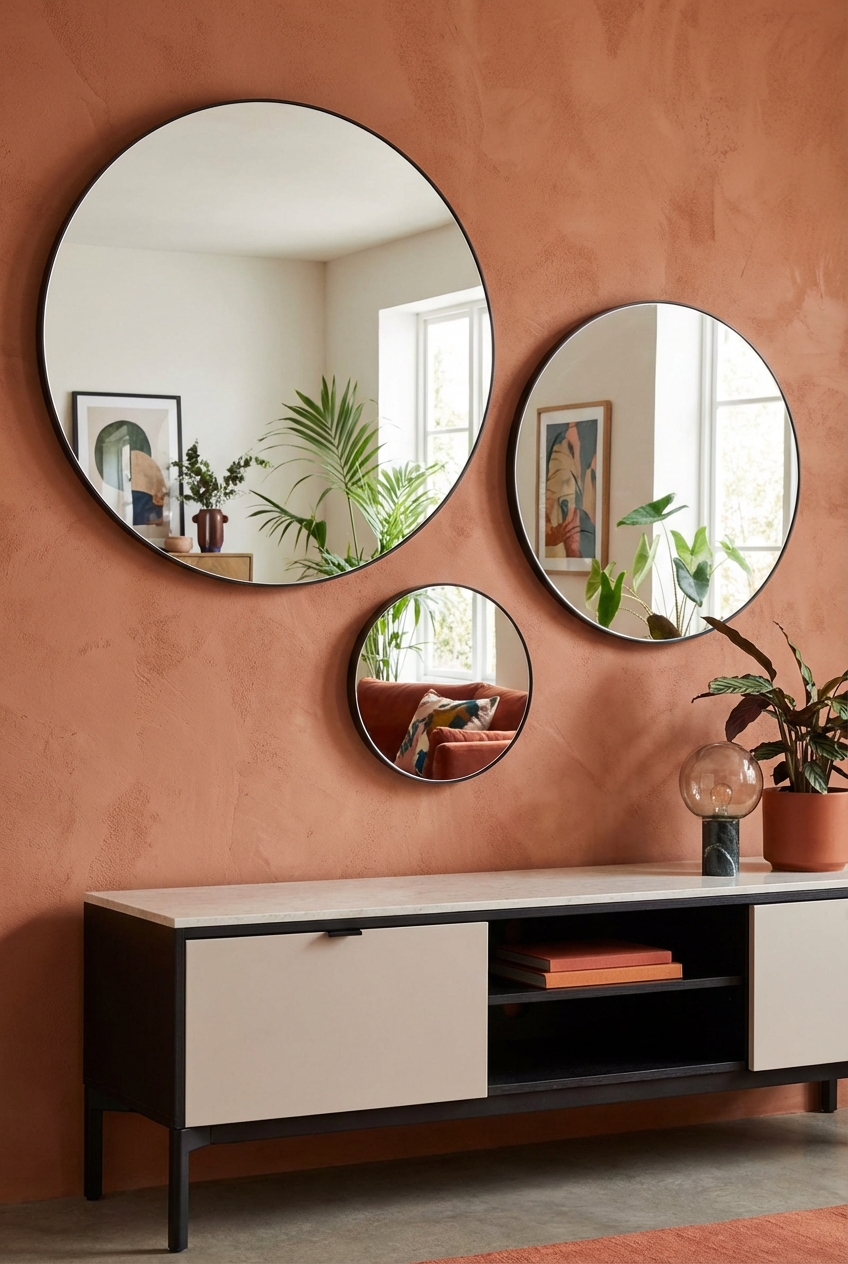
If you are hanging them above furniture, the rules change slightly. The bottom of the lowest mirror should sit 6 to 10 inches above the top of the furniture piece.
Relation to Furniture Width
If you are hanging your trio above a console table, sofa, or buffet, pay attention to width. The total width of your mirror arrangement (including the spaces between them) should span about two-thirds to three-quarters of the furniture’s width.
If the mirrors extend beyond the edges of the furniture below, the arrangement will look top-heavy and unstable.